DNA Contradictions: What the Idaho4 Case Teaches Us About “Touch DNA”
Mainstream coverage of the Idaho4 case has turned the sheath DNA into a kind of myth. Fox News even called it “catastrophic” and “tons of DNA,” suggesting it was overwhelming proof against Bryan Kohberger. But the actual court filings tell a different story, one filled with caveats, restrictions, and warnings from judges about misleading terms.
The truth is simple: DNA evidence is powerful, but it’s also easy to oversell. Courts themselves have acknowledged that low-level samples don’t prove direct contact, presence at a crime scene, or guilt. Let’s break down the contradictions.
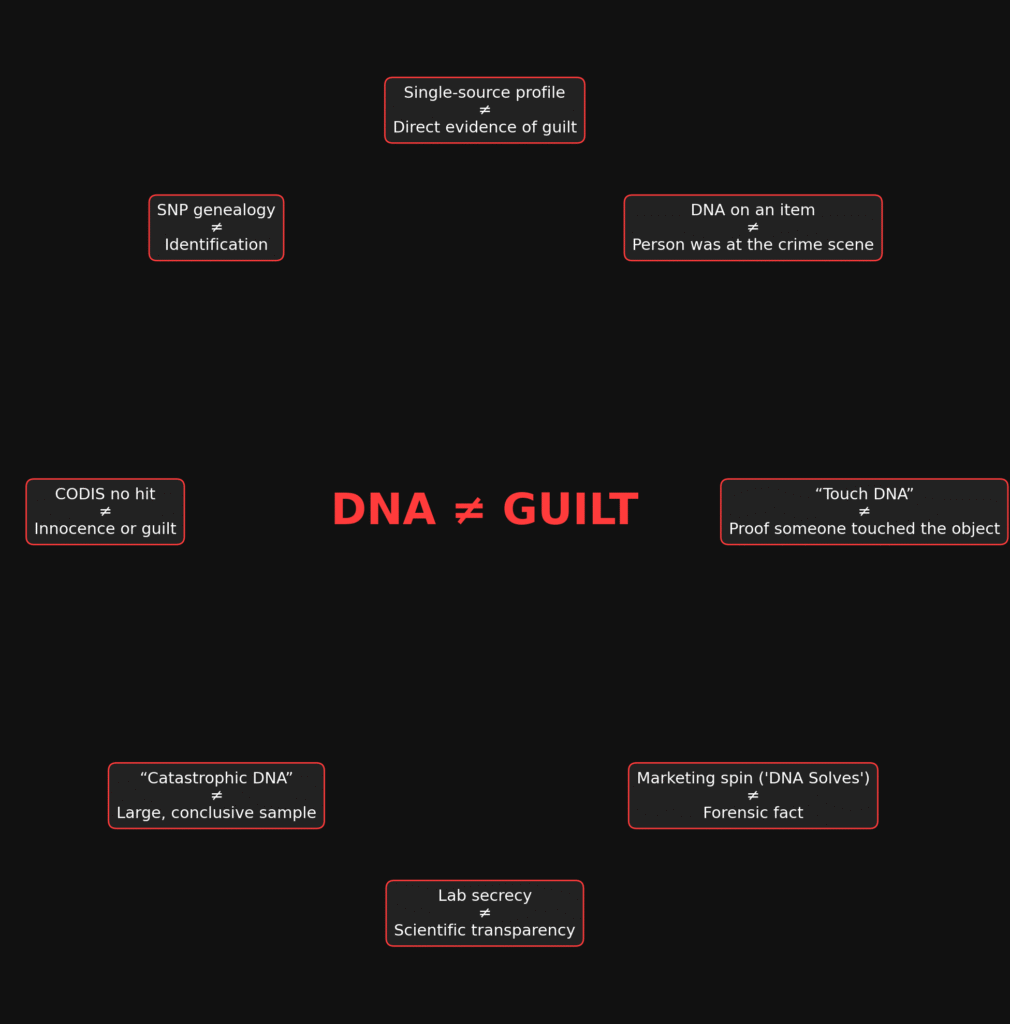
⚖️ The Visual Analogy: DNA ≠ What They Claim
- “Touch DNA” ≠ Proof someone touched the object
→ DNA can transfer second-hand (through another person or object).
- DNA on an item ≠ Person was at the crime scene
→ DNA persists; it could have been deposited days, weeks, or months earlier.
- Single-source profile ≠ Direct evidence of guilt
→ It only means the profile is consistent, not that the person left it.
- SNP genealogy ≠ Identification
→ SNPs generate investigative leads; STR confirmation is required.
- CODIS no hit ≠ Innocence or guilt
→ It only means the DNA wasn’t in the national database – nothing more.
- “Catastrophic DNA” ≠ Large, conclusive sample
→ In Idaho4, the sheath trace was 0.0168 nanograms – less than a single cell.
- Lab secrecy ≠ Scientific transparency
→ The State refused to release raw SNP/STR files, citing Othram’s “contractual restrictions”.
- Marketing spin (“DNA Solves”) ≠ Forensic fact
→ Not all DNA solves; some DNA only confuses, misleads, or points to the wrong people.
Why This Matters
In Kohberger’s case, the only probative DNA came from the snap of the knife sheath DNA. That single trace returned no CODIS hit. Investigators then sent the sample to Othram for SNP genealogy. Only after that process did the FBI create a lead with Kohberger’s name.
The defense requested Othram’s raw lab files many times. The State refused and claimed the records were proprietary. Judges later restricted terms like “touch DNA,” “contact DNA,” and “trace DNA.” They wanted to prevent jurors from assuming certainty where none existed.
Yet in 2025, headlines claim “catastrophic DNA” covered the house. That headline does not reflect reality.
The Bigger Picture
This issue extends beyond one investigation. Media spin can reshape public understanding of forensic science. Reporters often treat knife sheath DNA or any microscopic trace as absolute proof. That belief puts innocent people at risk.
IGG is not identification. It only generates leads. But when framed as “DNA solves,” the public sees it as final and infallible. Jurors may also assume certainty where science shows none.
Closing Thought
DNA is a tool, not a verdict. The Idaho Murders expose this truth clearly. Knife sheath DNA ≠ guilt. Until courts, labs, and media outlets present DNA honestly, we risk turning science into an engine of injustice.