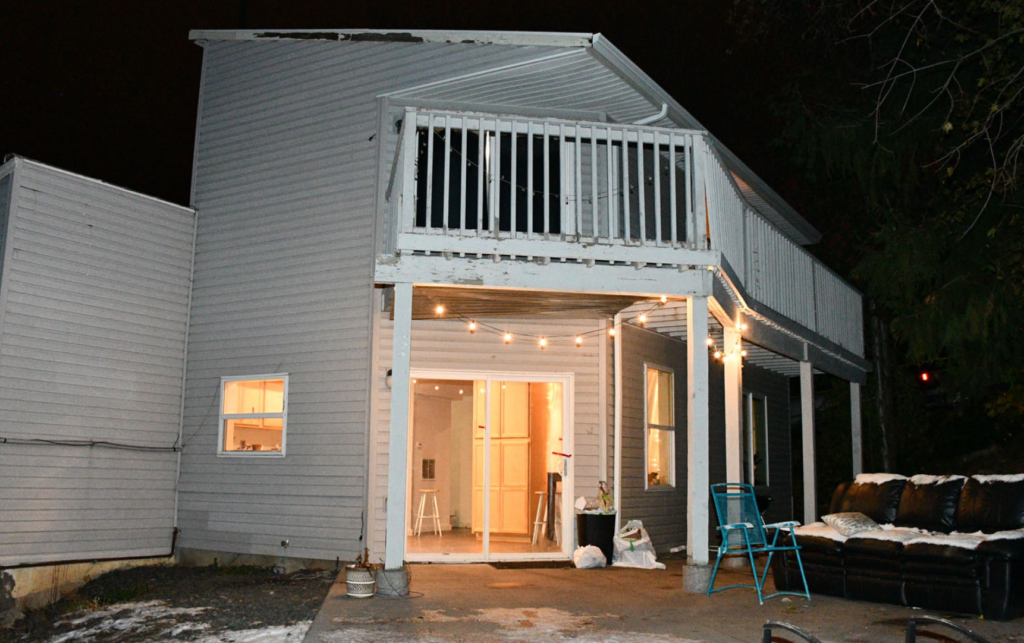
1. Dylan Mortensen’s Statements as the Narrative Backbone
Dylan Mortensen provided the only detailed account of what allegedly happened inside the King Road house on the night of the murders.
Her statements helped establish several key parts of the prosecution’s timeline, including:
- The sequence of noises inside the house.
- Kaylee reportedly saying, “Someone’s here.”
- Sounds described as running up and down the stairs with the dog.
- Hearing a male voice allegedly say, “It’s okay, I’m here to help you.”
- Opening her bedroom door multiple times.
- Seeing a masked man dressed in black walk past her toward the kitchen (his entire description).
This account became the foundation for the State’s timeline and theory of how the attack unfolded inside the house.
2. Documented Inconsistencies and Problems in Her Account
There are several issues and inconsistencies in Dylan Mortensen’s account that raise questions about how heavily the State’s case depends on her statements. Here’s a few examples.
Who initiated contact:
Dylan claimed she heard noises and contacted others. However, records reportedly show Bethany called her first. Dylan missed that call and then called Bethany back. She also said she didn’t know if Xana or Ethan were home yet, she ran past Xana and knew she was wearing underwear. And her first calls were to Xana, Ethan, and Kaylee.
Lack of a clear trigger:
Dylan never gave a fully consistent explanation of what specifically woke her, despite living in a room described by former residents as having very little sound insulation.
Timing of communications:
Key texts and calls between Dylan and Bethany occurred after the murders, according to the State’s own timeline placing the car fleeing around 4:20 a.m.
Minimization and tone:
Dylan described telling a contact she saw someone in the house, with an alleged response along the lines of, “That could be anyone, you guys got a party house.” That minimizing reaction does not clearly align with how someone would normally respond to a genuinely frightened person reporting a masked intruder.
Contradictions about who was home:
Dylan gave conflicting information about whether she knew Xana and Ethan were in the house that night.
911 call behavior:
The 911 call details also raise questions. Instead of immediately describing the full scene, Dylan reportedly minimized details, including saying Xana was “not waking up,” while the masked man narrative became an early focus.
3. Phone Records and Communication Issues
The content of the calls and texts between Dylan and Bethany appears to have been provided largely through Dylan’s own description rather than through clearly documented, independently recovered phone records.
There does not appear to be clear documentation in the investigative record showing that police independently obtained and reviewed the full content of those communications in the same way other evidence is normally documented.
That leaves the State relying heavily on Dylan’s description of what was said, rather than objective records showing the complete communication history.
4. Blocked Ability to Challenge Her Reliability
The defense attempted to introduce an expert witness to challenge Dylan Mortensen’s reliability as an eyewitness, including issues involving stress, memory, perception, and recall.
That expert was blocked by the court.
Because Dylan’s statements form the core of the State’s narrative about what happened inside the King Road house, restricting the defense from testing her reliability created a significant limitation.
5. How Other Evidence Depends on or Is Weaker Than Her Account
The other evidence in the Idaho murders case does not independently establish the full inside-the-house narrative without relying on Dylan’s account.
Sheath DNA:
The sheath involved touch DNA, which does not prove when or how DNA was transferred. The IGG process used to develop the lead had documented limitations, and the defense was heavily restricted in accessing raw data and lab records.
Vehicle evidence:
The white car identification came from low-quality infrared footage, included an initial model-year error, and did not provide a readable license plate. It is circumstantial and does not independently place anyone inside the house.
Cell site data:
The cell data is imprecise, especially in a rural area and considering Kohberger lived less than 10 miles away. It does not prove presence at the specific house at the exact time of the murders. There was also missing timing advance files.
Timeline of the murders:
The State’s timeline is largely built around Dylan’s statements rather than independent forensic time-of-death indicators, such as body temperature or other objective forensic measurements. Although the white car passes earlie
6. Court Record Imbalance
Chapter 10 of the book, Already Inside, examines the imbalance in the court record.
The defense filed 52 major motions and won only 3 outright.
The State filed 18 major motions and won 12 outright.
Repeated defense denials involved IGG discovery, expert witnesses, including Dylan’s reliability expert, the “hot docs” index, and sanctions.
The court consistently restricted the defense’s ability to challenge key evidence and the central witness, while giving the prosecution wide latitude.
7. Summary of the Structural Problem
The State’s case on what actually happened inside the King Road house rests primarily on one witness whose statements contain multiple documented inconsistencies, gaps, and accuracy issues.
The defense was repeatedly blocked from properly testing that witness’s reliability or the forensic evidence used to support the State’s narrative.
Other physical and circumstantial evidence is either weak on its own or depends on accepting Dylan Mortensen’s account as largely accurate.
This created a situation where the prosecution’s theory became difficult to meaningfully challenge in court, even in a death penalty case.
Final Analysis
The Idaho murders case is heavily dependent on Dylan Mortensen’s statements because her account supplies the internal timeline, the masked man description, and the sequence of events inside the King Road house.
When those statements contain inconsistencies, unanswered questions, and communication gaps, the entire structure of the State’s narrative becomes vulnerable.
The issue is not whether one witness matters. The issue is whether a death penalty case should rest so heavily on one witness account while the defense is restricted from fully challenging that account’s reliability.