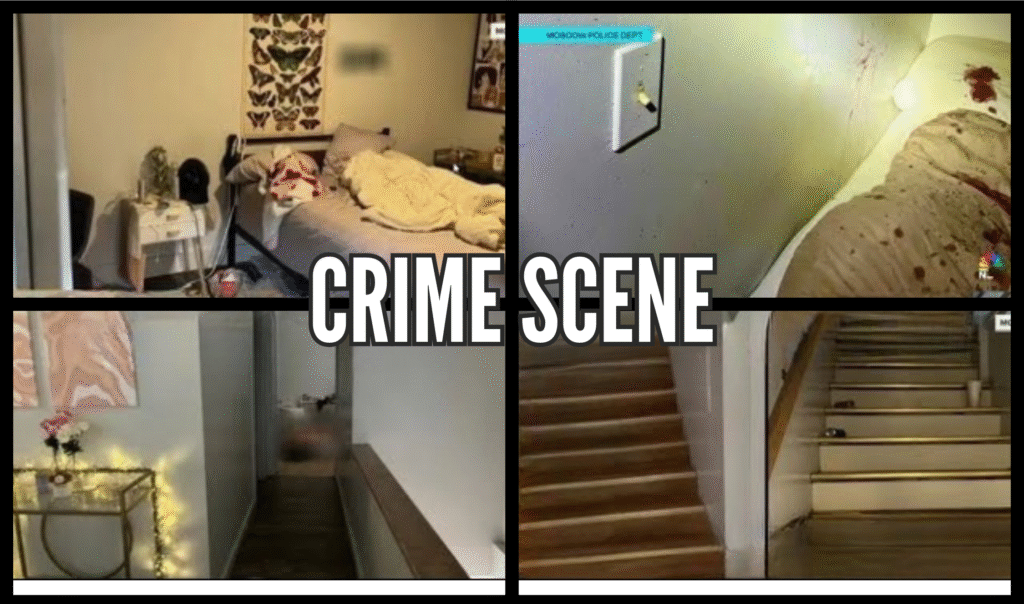
One of the most confusing parts of the case has always been the account of surviving roommate Dylan Mortensen. In the early bodycam footage that night, Dylan herself said she was yelling her roommates’ names. Later, her story was reframed as being “frozen in shock.”
But those two states don’t coexist.
Frozen = silent, paralyzed.
Yelling = active, deliberate.
You can’t be both.
And then comes the overlooked detail almost no one talks about:
At 3:51 a.m., Dylan saved a new contact into her phone.
People who are “frozen in fear” are not calmly updating their contacts in the middle of a crisis. Saving a contact is intentional — it means she was talking to someone, texting someone, or preparing for someone outside to arrive.
Even more, in a college party house where chaos is normal, there are really only two instinctive reactions to noise:
-
Ignore it completely (scroll your phone, headphones in)
-
Go check what’s happening
Standing still in fear while yelling into the dark isn’t a real-world response.
Unless Dylan already knew who was involved.
The Kitchen Choke Point
Xana’s DoorDash arrived by 3:56 a.m. The driver got lost, walked around, and returned. By 4:06, a vehicle was seen doing a 3-point turn. By 4:08, it was parked.
Here’s the problem:
If the killer entered around that time, they would have confronted Xana in the kitchen first.
Her food was on the counter. She had just walked down to get it.
That confrontation never happened.
So the only timeline that works is:
The killer was already inside before 4:01 a.m.
The Scream-to-Stairs Sequence
Witness audio captured scream-crying in the bathroom, then someone running down the stairs. That sequence matches a fight between people who know each other, not a silent stranger drifting through a house of sleeping students.
If the conflict started on the second floor with Xana and Ethan, Kaylee may have run down to intervene, collided with the situation, then sprinted back upstairs. Suddenly, Dylan yelling Kaylee’s name makes sense — she wasn’t scared of an intruder. She was trying to stop Kaylee from running toward the fight.
This is not the behavior of someone hiding from a masked killer.
This is the behavior of someone caught in the middle of a fight they recognized.
The Only Theory That Fits
Every angle of this case collapses under the official story:
-
Dylan saving a contact at 3:51 a.m.
-
The kitchen timing
-
The lack of a first-floor confrontation
-
The scream-to-stairs sequence
-
The contradictions about being “frozen” vs. yelling
None of it works — unless the killer was already inside.
That’s why the Guest Theory is the only framework that explains it all.
It answers every major question:
-
Why Dylan yelled instead of hiding
-
Why the kitchen confrontation never occurred
-
Why the timeline only works if someone was inside before the roommates returned
-
Why the surviving roommates’ phone activity suddenly spikes at 4:18 and 4:26
Why It Matters
This case isn’t just about contradictions. It’s about four young lives,
Maddie, Kaylee, Xana, and Ethan — who deserve truth.
Justice cannot rest on a narrative that contradicts human behavior, physical layout, and the digital timeline.
Already Inside: Maddie Mogen’s Last Message to the World — the first book to fully break down the Guest Theory, backed by documents, timelines, and analysis the public has never seen.